
Artificial intelligence is no longer limited to innovation labs or pilot projects. In 2026, enterprises are integrating AI into customer service, financial operations, healthcare, manufacturing, cybersecurity, and countless other business functions. As AI adoption continues to grow, organizations are investing not only in model development but also in ensuring these systems operate reliably and responsibly.
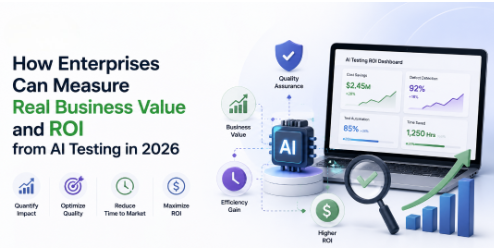
While many enterprises recognize the importance of quality assurance, measuring the return on investment from AI testing services remains a challenge. Unlike traditional software testing, AI testing delivers value across multiple dimensions, including model accuracy, operational efficiency, regulatory compliance, customer trust, and long-term business performance. Looking only at the number of defects found or the cost of testing provides an incomplete picture.
Understanding how to measure the business impact of AI testing enables organizations to make better investment decisions while building more dependable AI-powered products.
Why ROI Looks Different for AI Testing
Traditional software testing often measures success using metrics such as defect density, test coverage, automation rates, or execution time. While these indicators remain valuable, they do not fully capture the business outcomes associated with AI systems.
AI models continuously evolve as they learn from new data. Their performance may change over time, introducing risks that extend beyond software functionality. An inaccurate recommendation engine, biased recruitment model, or unreliable fraud detection system can directly affect revenue, customer experience, and regulatory compliance.
Because of these characteristics, enterprises should evaluate artificial intelligence testing services using both technical and business-focused metrics.
Define Business Objectives Before Measuring ROI
Every AI initiative should begin with clearly defined business goals. Without measurable objectives, demonstrating the value of testing becomes difficult.
Organizations should identify questions such as:
- What business problem does the AI system solve?
- Which outcomes define project success?
- What risks could affect business performance?
- Which quality metrics influence customer satisfaction?
For example, an AI-powered customer support solution may aim to reduce response times while maintaining high resolution accuracy. A predictive maintenance system may focus on reducing equipment downtime. These objectives become the foundation for measuring testing effectiveness.
Measure Model Accuracy Against Business Outcomes
Model accuracy remains one of the most important indicators of AI quality, but it should always be connected to business value rather than viewed as an isolated technical metric.
Instead of simply reporting accuracy percentages, enterprises should evaluate how improved model performance affects operational efficiency, customer satisfaction, revenue, or cost savings.
For example:
- Higher fraud detection accuracy can reduce financial losses.
- Better recommendation quality can increase conversions.
- Improved forecasting accuracy can optimize inventory planning.
- More reliable document processing can reduce manual effort.
Professional AI testing services help organizations validate these outcomes before deployment, reducing the likelihood of costly production failures.
Evaluate the Cost of AI Errors
One effective way to calculate ROI is by estimating the business impact of AI failures.
Potential costs may include:
- Incorrect business decisions
- Customer dissatisfaction
- Compliance violations
- Operational disruptions
- Reputation damage
- Increased support costs
Testing helps reduce these risks by identifying weaknesses before AI systems are deployed into production.
Rather than viewing testing as an operational expense, enterprises should consider it a risk reduction investment that protects long-term business value.
Track Productivity Improvements
AI testing also contributes to development efficiency.
Well-tested AI applications typically require fewer production fixes, shorter debugging cycles, and fewer emergency releases. Development teams spend less time resolving unexpected issues and more time delivering new capabilities.
Useful productivity metrics include:
- Faster release cycles
- Reduced defect resolution time
- Lower production incident rates
- Improved deployment success
- Shorter validation cycles
These operational improvements often generate measurable financial benefits over time.
Measure Customer Experience and Business Impact
The success of an AI system should ultimately be measured by the value it creates for users and the business. Reliable AI applications improve customer interactions, strengthen decision-making, and enhance operational efficiency.
Organizations can evaluate business impact using metrics such as:
- Customer satisfaction scores
- Task completion rates
- Prediction success rates
- Reduced manual intervention
- Increased operational efficiency
- Revenue growth linked to AI-driven features
Tracking these indicators helps demonstrate how testing contributes to tangible business outcomes instead of focusing only on technical performance.
Include Compliance and Risk Reduction in ROI
Many AI applications operate in regulated industries such as healthcare, banking, insurance, and public services. In these environments, AI failures can result in financial penalties, legal challenges, and reputational damage.
Comprehensive AI software testing services help organizations identify issues related to fairness, data quality, security, and explainability before deployment. Preventing compliance failures often delivers substantial financial value, even when those benefits are not immediately visible through traditional ROI calculations.
Reducing business risk should be considered an important return on every AI testing investment.
Monitor AI Performance After Deployment
AI testing should continue after deployment because models evolve over time. New data, changing user behavior, and updated business conditions can affect prediction quality.
Enterprises should continuously monitor:
- Model accuracy
- Data drift
- Prediction consistency
- Response times
- System availability
- Error rates
Ongoing monitoring enables teams to identify declining performance early and retrain models before business operations are affected. Continuous validation also provides valuable insights for future optimization.
Build ROI Around Long-Term Value
The true value of AI testing extends beyond a single release. Organizations that invest in structured testing practices build more reliable AI systems, improve customer trust, and reduce long-term maintenance costs.
Benefits often include:
- Higher software quality
- Greater release confidence
- Faster innovation
- Lower operational costs
- Improved customer retention
- Better business decision-making
These outcomes create lasting value that supports enterprise AI initiatives well beyond initial deployment.
Best Practices for Measuring AI Testing ROI
Organizations can establish a more meaningful ROI framework by following several best practices:
- Define measurable business goals before development begins.
- Align testing metrics with business outcomes.
- Measure both technical and operational performance.
- Track production performance after deployment.
- Include compliance and risk reduction in ROI calculations.
- Review testing metrics regularly to identify improvement opportunities.
A balanced measurement strategy helps business and engineering teams understand how testing contributes to overall organizational success.
Conclusion
As AI becomes central to enterprise operations, measuring the value of testing requires a broader perspective than traditional quality metrics alone. Organizations should evaluate how AI testing services improve model reliability, reduce operational risk, enhance customer experiences, and support better business outcomes.
Enterprises that invest in structured artificial intelligence testing services are better positioned to deploy trustworthy AI applications while minimizing costly failures and compliance risks. Rather than treating testing as an isolated development activity, successful organizations integrate it into their overall AI strategy to maximize long-term business value.
For enterprises looking to strengthen their AI quality assurance practices, QAble provides AI & ML Testing Services that help organizations validate intelligent applications, improve model performance, and build reliable AI systems that support confident business growth.
Previously in Technology: How Digital Tools Are Making Technical Calculations Faster and More Accessible