
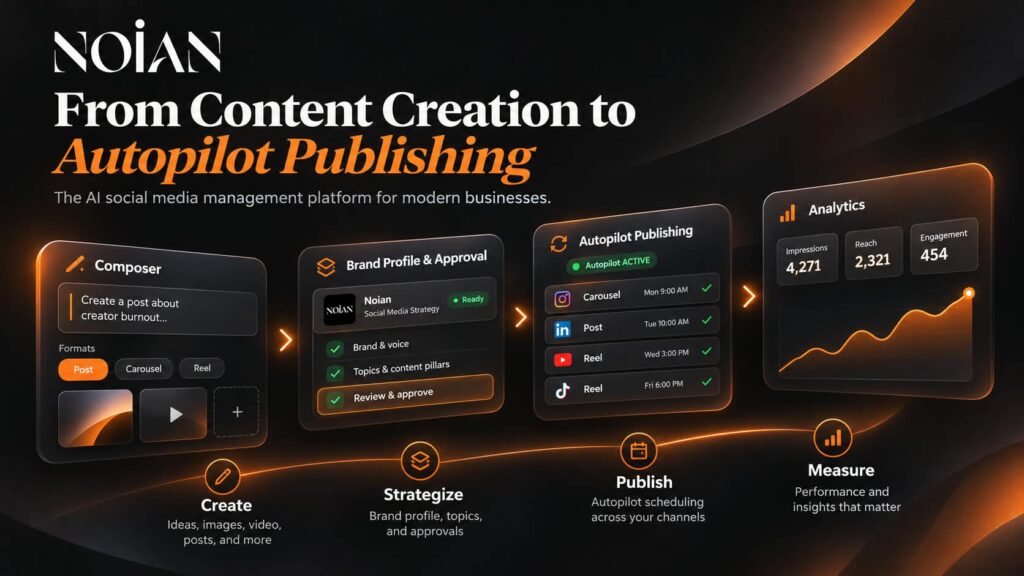
As AI makes content easier to produce, a different challenge is emerging for businesses: connecting brand strategy, images, videos, approvals, and publishing into one reliable system.
Creating a social media post has become remarkably easy. Maintaining a social media presence hasn’t.
A business owner can generate a caption in seconds, create an image without a designer, or turn a few product photographs into a short promotional video. Yet the same owner may still spend hours switching between applications, rewriting posts for different platforms, adjusting video formats, checking publication schedules, and wondering whether anything has actually reached the intended audience.
The problem is no longer simply content production. It’s everything surrounding it.
That distinction is changing what businesses should expect from AI social media management. Rather than treating artificial intelligence as a writing assistant, newer platforms are beginning to connect the entire content lifecycle, from the first idea to the published post and its subsequent performance.
Noian, founded by Arel Aslan, an entrepreneur and full-stack product builder based in Istanbul, is approaching this problem through a unified content creation and publishing environment. Its platform combines brand-aware AI, image and video production, content planning, scheduling, approval controls, and automated distribution across connected social media accounts.
The underlying proposition is straightforward: businesses should spend more of their time deciding what is worth communicating and less time operating the machinery required to communicate it.
What AI social media management actually means in 2026
AI social media management is the use of artificial intelligence to plan, create, review, schedule, publish and measure social media content across multiple platforms, within rules and approvals set by the business. It is broader than an AI caption generator and broader than a traditional social media scheduler. The creation, the distribution and the learning loop happen in the same system, using the same brand context.
That definition matters, because most tools still do only one of those jobs well.
Why producing more content isn’t enough
Consider a small e-commerce business preparing to launch a new product.
The marketing work doesn’t begin with writing an Instagram caption. Someone needs to establish the product’s positioning, select photographs, identify the most persuasive selling points, and decide which audiences might be interested.
That information then needs to become different assets: perhaps a short product video for TikTok, an Instagram carousel, a Pinterest Pin, a Facebook announcement, and a LinkedIn post explaining the thinking behind the product.
Each asset has its own production requirements. Video needs footage, timing, music, subtitles, and appropriate dimensions. Image posts need visual consistency. Text requires a tone that suits both the brand and the destination platform.
And all of those assets must eventually be reviewed, scheduled, and published.
A standalone AI writing tool might accelerate one part of this process, but it doesn’t necessarily eliminate the coordination work. That is why the emerging category of AI-powered social media management tools is becoming more interesting than another generation of caption generators. The real opportunity lies in bringing creation and execution together.
Building content around a recognizable brand
One persistent weakness of automated marketing is that AI-generated material often sounds interchangeable.
A law firm, a fitness studio, and a clothing retailer can receive similarly enthusiastic language even though their customers, professional expectations, and communication styles are completely different. Generic content may be grammatically correct while contributing almost nothing to brand recognition.
Noian addresses this through its Brand Profile and topic-based content system: businesses establish information about their identity, sector, audience, and preferred communication style, then organize the subjects they want to discuss into recurring content topics and angles. It works as an AI social media manager that already knows the business, instead of a generic generator starting from a blank prompt every time.
Instead of asking AI to invent a new brand personality every time, the system can draw on an established body of context.
This matters particularly for businesses without dedicated marketing departments. A small professional-services company may want informative, restrained language. A consumer brand might prefer more energetic storytelling. An independent founder may want content that reflects personal expertise rather than conventional corporate messaging.
The goal is not to make every post sound identical. It is to make different posts recognizably originate from the same business. That brand context also creates a foundation for more systematic content planning.
From a single idea to images, carousels, and AI-generated videos
Text is only one component of social media marketing. Short-form video, product photography, educational carousels, and visual storytelling have become central to how businesses communicate across different networks.
Producing these assets traditionally involves multiple tools: one for generating ideas, another for designing graphics, a video editor for assembling footage, and a separate scheduling service to distribute the results.
Noian brings several of these production tasks into its content creation environment. Users can work with AI-generated images, stock visuals, their own media assets, and different video creation options. The platform supports videos assembled from photographs or clips with voiceovers, subtitles, and background music, alongside AI-filmed videos that generate footage from written scenes.
The distinction is meaningful. A restaurant promoting a new menu might already have excellent food photography. Turning those assets into a short narrated video may be more appropriate than generating fictional restaurant footage. A software business, meanwhile, may benefit from a combination of product screenshots, explanatory graphics, and short demonstrations.
The technology is useful when it helps businesses choose the appropriate production method, not merely when it produces the largest amount of AI-generated media.
For businesses evaluating AI content creation tools, this is an important distinction. Generating an asset and preparing that asset for publication are closely related tasks, but they are not the same task. A useful system should support the movement between them without forcing the user to rebuild the content at every step.
One content strategy, different platforms
A common shortcut in social media marketing is to publish the same text and visual everywhere. It saves preparation time, but frequently ignores how audiences behave on different platforms.
A LinkedIn audience might appreciate a founder’s explanation of why a product was developed. Instagram may be better suited to showing the product in action. A TikTok video might focus on a demonstration or a common customer problem, while a Pinterest Pin could emphasize a useful visual guide.
The central idea remains consistent. Its execution changes.
This is where multi-platform social media publishing becomes more complicated than connecting several accounts to a scheduler. Noian supports content preparation and publishing workflows across services including Instagram, Facebook Pages, LinkedIn, TikTok, YouTube, Pinterest, and Google Business Profile, using authorized account connections and platform-specific publishing options. The system allows users to prepare content for selected destinations while accounting for the formats and publishing capabilities of those networks.
For an independent business, this can reduce a familiar source of operational friction: repeating essentially the same production process across a collection of disconnected platforms. It also encourages an important editorial discipline. A business should not publish on a platform simply because the platform is available. The right channels are the ones where its audience and content genuinely belong.
Moving from scheduling to autopilot publishing
Scheduling tools have existed for years. They allow users to prepare content in advance and select when it should appear.
Autopilot publishing goes further by coordinating recurring content plans, generation, review states, and distribution rules within a single workflow. Noian’s approach is social media automation with human approval: users can configure publishing plans, manage connected accounts, review content in a queue, and control whether automation is active. Publishing frequency and other operational rules are configurable, allowing the system to handle recurring activity without treating every available posting slot as an obligation to publish.
This is also where automation needs safeguards. Generating an inaccurate statement is one problem. Automatically distributing that statement across several accounts is a larger one.
Noian describes a quality-control process that evaluates drafts for brand consistency, readability, and risk signals before publication. The platform also incorporates approval workflows, posting limits, review settings, and controls to pause automated activity. Users can authorize the publishing behavior permitted within their configuration, with manual review available for content requiring a decision.
The distinction between assistance and unchecked autonomy matters. An effective system should automate repeatable production and coordination tasks while preserving human responsibility for what appears under a company’s name. Approval notifications, including Telegram-based review options, offer another practical way of managing that responsibility without requiring business owners to monitor a dashboard continuously.
The result is a different interpretation of social media automation: not software that publishes as much content as possible, but a controlled process for keeping approved content moving.
Approval notifications on Telegram
Nothing goes live without your OK. When a draft is ready or a post needs attention, Noian sends an approval notification to the connected Telegram account, with the content itself attached. The owner can review it on their phone and approve it there — no dashboard login, no laptop, no chasing a queue. Only after that approval does the post publish, on the schedule the plan sets.
For a founder or store owner, this is the control point that makes autopilot practical. The system does the repetitive work continuously, but the decision stays one tap away, in an app the owner already checks every day. Reject or ignore the notification, and nothing publishes. That single notification is the difference between automation you trust and automation you switch off.
Why the last mile of publishing matters
Content creation receives most of the attention in discussions about generative AI, but distribution is where many otherwise useful workflows become inefficient.
A finished video still needs to reach the correct account. Captions, assets, destinations, permissions, and publishing times must be coordinated. Failures need to be visible so that users know whether an item was published, delayed, or held for review.
Noian connects social accounts through the platforms’ official authorization procedures, rather than requiring businesses to share their social media passwords. This gives the publishing workflow an authenticated connection to the destinations selected by the user.
For growing businesses, especially those operating several brands or social profiles, such coordination can become more valuable than shaving a few seconds from caption generation. The cost of manual social media management is not confined to the time spent typing. It also includes fragmented attention, switching between tools, repeated decisions, and the administrative work required to maintain consistency. Reducing that operational burden is one of the more practical applications of AI in marketing.
Analytics should inform what gets created next
Publishing completes the distribution process, but it shouldn’t end the editorial process.
Businesses need to learn which topics interest their audiences, which formats generate meaningful responses, and whether their social activity supports broader commercial goals. A post can accumulate impressions without producing a single useful customer interaction. A smaller post, reaching a more relevant audience, might generate a valuable inquiry.
That is why social media analytics should be interpreted in context rather than treated as a scoreboard.
Noian’s analytics workspace provides visibility into published content and engagement measures across connected platforms, including metrics such as impressions, reach, likes, comments, shares, and clicks where supported.
Such data can support future editorial decisions: which topics deserve another treatment, where a video format is proving useful, and where a publishing schedule may need adjustment. It does not replace business judgment, and engagement metrics alone do not establish return on investment. Their usefulness comes from helping teams make better choices about what to produce and distribute next.
From a Shopify catalog to published social content
For e-commerce merchants, the starting point is not a blank page at all. It is the product catalog. The Noian Social Content Manager for Shopify connects that catalog to the same Brand Studio workflow: products become ready-to-post videos and captions, with images, music, voiceover and subtitles, and finished content can auto-publish to Instagram, TikTok, Facebook, LinkedIn, Pinterest, YouTube Shorts and X.
That changes the economics of store content. A merchant does not need a separate shoot, edit and posting session for every product. New and existing products can be turned into a steady stream of short product videos and posts, in the store’s own brand voice, while the catalog itself supplies the facts: the product, its photographs and its selling points.
Control stays with the merchant here too. Drafts can be sent for Telegram approval before anything publishes, so a store owner can check a product video on their phone and approve it in one tap. The free tier’s videos are simple product-image videos with voiceover and subtitles, which is often exactly what a small store needs to stay visible between launches.
It is the same principle as the rest of the platform, applied to commerce: the system starts from what the business already has — its products — and handles the production and publishing machinery around it.
What this means for small businesses and lean marketing teams
Large businesses can divide content strategy, copywriting, design, video editing, social media operations, and analytics among specialized employees. Smaller companies rarely have that luxury.
The founder may also be the marketing manager. A store owner might be responsible for photography, promotional campaigns, customer inquiries, and publishing. A small agency may handle several clients with a team that cannot afford to spend hours on repetitive manual tasks.
That founder-led reality is also what shaped Noian. Arel Aslan built the platform after more than 20 years in digital marketing, much of it spent watching small businesses lose hours to exactly this coordination work — switching tools, reformatting the same content, and publishing by hand.
This makes connected content systems particularly relevant. A business doesn’t necessarily need to produce content at enterprise scale. It needs a repeatable way of translating its own expertise and products into suitable posts without allowing social media to consume the working day.
Noian also provides industry-specific social media guides for different business types, reflecting the fact that a restaurant, real estate professional, dental practice, and fitness business will require different content strategies. Its guides illustrate why effective automation must begin with an understanding of the business rather than treating all audiences as interchangeable.
The objective is not to eliminate the human perspective from content. It is to make that perspective easier to communicate consistently.
The next phase of AI social media management
Generative AI has significantly lowered the technical barrier to creating marketing content. The next challenge is making that content useful, recognizable, reviewable, and publishable without introducing another collection of disconnected tools.
That requires more than advanced language generation. It involves brand context, content strategy, visual production, platform-aware formatting, authenticated distribution, review controls, automation policies, and performance measurement operating together.
Platforms such as Noian illustrate the shift from standalone AI content tools toward integrated publishing systems. The commercial promise is not that a machine can invent a successful brand or replace the judgment behind good marketing. It is that businesses can devote more attention to customers, products, and ideas while technology handles a larger share of the repetitive execution.
AI has made content creation faster. The more consequential question now is whether it can make the entire publishing process more coherent.
Author bio
Arel Aslan is an entrepreneur, MBA and full-stack product builder based in Istanbul, with 20+ years in digital marketing. He is the founder of Noian Brand Studio, an AI social media management platform that helps businesses create, approve, schedule and auto-publish on-brand content across Instagram, Facebook, LinkedIn, TikTok, YouTube, Pinterest and Google Business Profile, with human approval before anything goes live. Connect with him on LinkedIn: linkedin.com/in/arelaslan.