
Warehouse teams evaluating automation often begin by comparing payload, travel speed, and navigation technology. Those specifications matter, but they do not explain the full difference between a conventional automated guided vehicle and a newer AI-native pallet-handling robot. Moving a pallet reliably requires a system to find the load, recognize its carrier, approach it accurately, understand the space occupied by the cargo, respond to changing obstacles, and coordinate with other equipment.
The distinction is not simply that every AGV follows a fixed line while every AMR is intelligent. AGV and AMR are broad industry labels, and modern products can use a range of navigation methods. A more useful comparison looks at what the robot can perceive and decide during an actual material-handling task. Five areas help make that comparison practical.
1. Navigation Is Evolving from Following Routes to Understanding Space
Traditional AGV deployments have often relied on predefined guidance such as magnetic tape, wires, reflectors, or QR codes. These methods can be effective when routes and operating conditions are stable. More advanced automated vehicles may use laser navigation or simultaneous localization and mapping (SLAM), so buyers should avoid assuming that every AGV has the same limitations.
AI-native autonomy builds on navigation by combining localization with a broader understanding of the environment. The PUDU MP2000 uses 3D LiDAR-SLAM and VSLAM to localize and map its surroundings without requiring reflectors or floor markers. PUDU describes its multi-sensor navigation and edge intelligence as supporting site mapping and configuration without extensive site modification. For facilities where staging areas move, temporary inventory occupies aisles, or production lines are rearranged, the practical question is how easily routes can be updated and how the robot behaves when the mapped environment changes.
This matters as mobile robots become a larger part of industrial logistics. The International Federation of Robotics reported that 102,900 professional service robots for transportation and logistics were sold in 2024, a 14% year-over-year increase. The category represented more than half of the professional service robots recorded in that report. The figure is reported in the IFR’s World Robotics 2025 service-robot update. It points to the growing importance of transport automation, but it does not mean every facility has the same route or integration requirements.
A useful navigation assessment therefore goes beyond asking whether a robot uses SLAM. Buyers should test map creation, route editing, localization recovery, blocked-aisle handling, and operation around temporary staging. A system that reaches a coordinate under ideal conditions may still struggle when the route is partly obstructed or the destination changes during a shift.
2. AI Changes How a Robotic Forklift Finds and Engages Pallets
Reaching the pickup area is only the beginning of a pallet-handling task. The robot must identify the correct load carrier, locate the fork openings, estimate the pallet’s actual position, and determine whether the destination is available. These steps become more demanding when a facility receives pallets from several suppliers or handles a mix of standard and non-standard carriers.
Load-carrier recognition
A warehouse may use standard three-runner pallets, perimeter-base pallets, supplier-specific carriers, or other formats that are compatible with its handling process. Before selecting a robot, operations teams should document the carriers that actually appear on the floor rather than relying only on a purchasing specification. They should then confirm which formats the robot can recognize, which require configuration, and which are outside the supported range.
PUDU states that MP2000 supports standard three-runner and perimeter-base pallets and can automatically learn to recognize compatible non-standard load carriers. That capability is relevant to mixed inbound flows, but buyers should still validate their own carrier samples and fork-entry conditions during a site assessment.
Storage occupancy and pallet alignment
Knowing the location of a storage slot is different from knowing whether it is physically occupied. MP2000 detects storage-location occupancy and pallet positions, then uses that information to select a target for a pick or drop task. This can reduce reliance on assumptions that a digital location record always reflects the current physical state. During evaluation, ask how the robot verifies that a pallet is present, that a destination is available, and that a completed movement has been registered.
Pallets are also not always placed exactly on a marked position. Manual handling, earlier movements, and congestion can leave a pallet shifted or rotated. PUDU lists adaptive alignment for manually positioned pallets with up to 15 cm of positional offset and up to 15 degrees of angular deviation. Buyers should compare this published tolerance with the variation measured at their own pickup points; a stated tolerance is useful only when it covers the conditions that occur in the facility.
3. Clearance Planning Must Account for the Cargo, Not Only the Vehicle
After a pallet is picked up, the robot’s effective operating envelope changes. The chassis dimensions remain the same, but a wide load, overhanging carton, or irregularly stacked pallet may extend beyond the vehicle. Route planning that considers only the robot body can therefore miss the space required by the actual load.
PUDU describes MP2000 as detecting load dimensions and contours to calculate the space required for passage in real time. Its product information also lists handling of thresholds up to 10 mm and gaps up to 35 mm. These are product specifications, not a guarantee that every floor transition or aisle is suitable. A site trial should use representative loads and inspect rack corners, cross-aisles, staging zones, doorways, and any location where cargo may overhang.
The evaluation question changes from “Can the vehicle fit through this aisle?” to “Can the vehicle and the load it is carrying pass through this space with sufficient clearance under the planned operating conditions?” That is particularly important when pallet dimensions and load contours vary from task to task.
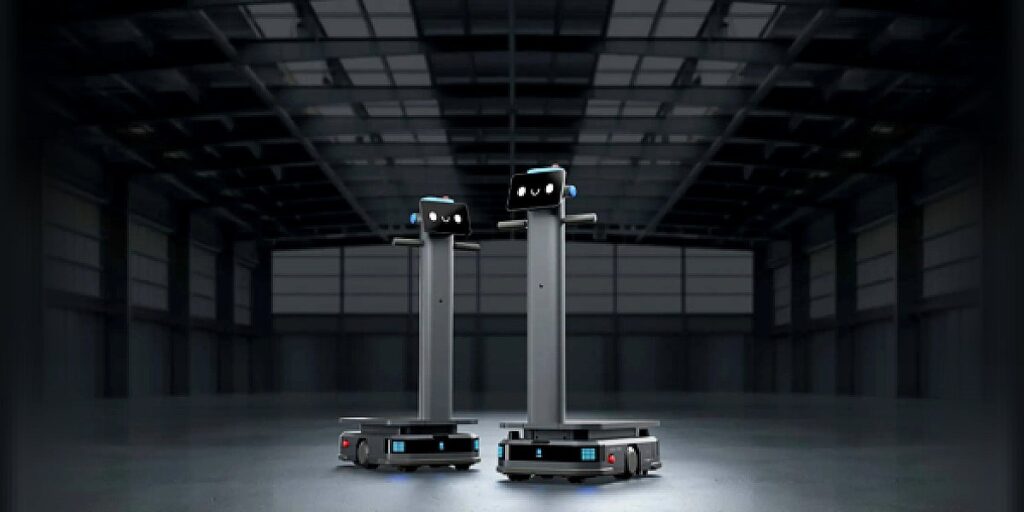
PUDU autonomous mobile robots shown in a warehouse environment.
4. Obstacle Detection Is Not Enough; the Robot Must Respond Appropriately
Most modern automated vehicles use sensors, so the statement that a robot can detect obstacles is not enough to distinguish one system from another. Buyers should ask what happens after an obstacle is detected. Does the vehicle stop and wait, avoid a moving object, or calculate a new route around a stationary obstruction? Are the responses different for people, forklifts, carts, and fixed equipment?
PUDU describes MP2000 as using depth cameras, 3D LiDAR, and other sensors for multi-layer environmental perception. Its product page says the system detects people, equipment, and obstacles in real time; dynamic obstacles can trigger avoidance or stopping, while static obstacles that block a planned path can trigger autonomous rerouting. These behaviors should be demonstrated in a controlled site test, including how the robot resumes work after the path becomes clear.
Automation does not remove the need for facility-level traffic management. OSHA guidance for powered industrial trucks emphasizes pedestrian awareness, clear travel paths, and separating pedestrian and vehicle traffic where possible. Although that guidance is written for powered industrial trucks, the underlying planning issues remain relevant when introducing mobile equipment into shared work areas. Review the facility’s pedestrian routes, blind corners, crossing points, emergency procedures, and aisle-clearance rules with the site safety team. See OSHA’s pedestrian-traffic guidance for general workplace considerations.
5. AI-Native Autonomy Extends from One Robot to the Fleet
A single robot can automate one transfer, but larger operations must coordinate multiple vehicles, shared pickup points, charging schedules, traffic intersections, and task priorities. Fleet coordination becomes important when several robots operate in the same zone or when pallet movements connect receiving, storage, production, and outbound areas.
PUDU describes MP2000’s fleet orchestration as distributed: individual robots make decisions and plan routes while communicating with one another. The company also states that coordinated operation can continue when the external network is temporarily unavailable. Buyers should ask the supplier to explain the exact operating conditions, what functions remain available during a network interruption, and how the system records or reconciles task status after connectivity returns.
Task dispatch and equipment handoffs also need to be understood. PUDU lists task input through PUDU Link, APIs, voice commands, and task buttons, with optional integration for elevators, automatic doors, and other IoT devices. During a project review, identify which system creates each task, what confirmation is returned, who handles exceptions, and which interfaces are included in the proposed configuration.
A Practical Comparison Checklist for Buyers
The following checklist keeps the comparison focused on operating capability rather than product labels. It can be used during supplier presentations, demonstrations, and site acceptance planning.
| Evaluation area | What to verify | Why it matters |
| Navigation | Mapping, route updates, localization recovery, blocked-route behavior | The facility layout and traffic pattern may change during operation. |
| Pallet recognition | Supported carrier types, non-standard carrier learning, fork-entry conditions | Inbound loads may not be perfectly standardized. |
| Alignment and occupancy | Position tolerance, angle tolerance, physical occupancy verification | Misplaced pallets and stale location records can interrupt tasks. |
| Load-aware clearance | Cargo contour detection, aisle clearance, floor transitions | The carried load changes the space required for travel. |
| Fleet and integration | Multi-robot coordination, task dispatch, offline behavior, device interfaces | A robot must fit into the wider material-flow process. |
Ask for demonstrations using the facility’s actual pallets, representative loads, and busiest traffic conditions. Request the supported operating limits and the conditions behind each published specification. A controlled demonstration is more informative than a feature list alone.
Conclusion
The most useful difference between a traditional AGV setup and an AI-native robotic forklift is not the label attached to the vehicle. It is the system’s ability to perceive the real load and environment, adapt to variation, respond to obstacles, and coordinate material movement with the wider operation. Buyers should compare these capabilities against their own workflows and verify them through a site-specific evaluation before deployment.
Previously in Artificial intelligence: How an AI-Powered Workspace Is Transforming Productivity and Efficiency