

In the realm of personal finance, the age-old adage “time is money” has never rung truer. As our financial lives grow increasingly complex, the traditional methods of managing money are being disrupted by a powerful new ally: artificial intelligence (AI).
No longer confined to science fiction, AI is revolutionising the financial landscape, offering sophisticated tools that can analyse, predict, and even act on our behalf. From robo-advisors that build bespoke investment portfolios to chatbots that offer personalised financial advice, AI is empowering individuals to take control of their financial futures like never before.
But what exactly is AI, and how is it changing the face of personal finance? How can we harness this cutting-edge technology to make smarter financial decisions and achieve our financial goals?
Understanding AI in Financial Planning
In simple terms, artificial intelligence refers to the ability of machines to mimic human cognitive functions such as learning, problem-solving, and decision-making.
- Machine Learning: The process of teaching computers to learn from data without explicit programming.
- Natural Language Processing: The ability of computers to understand and interpret human language, allowing for more natural and intuitive interaction.
- Neural Networks: Complex algorithms modelled after the human brain, capable of processing vast amounts of data and identifying subtle relationships.
These technologies, while complex under the hood, are already being seamlessly integrated into a wide range of financial tools and services, often without us even realising it.
AI-Powered Financial Planning: What Does It Look Like?
AI is not about replacing human financial advisors. Instead, it’s about augmenting their expertise with sophisticated tools that drastically reduce the decision-making process Here’s a glimpse of how AI is transforming personal finance:
- Robo-Advisors: These digital platforms use algorithms to create and manage investment portfolios based on your risk tolerance and financial goals. They offer a low-cost, accessible alternative to traditional financial advisors.
- Financial Chatbots: These virtual assistants can answer your financial queries, track your spending, and offer personalised advice 24/7. They’re like having a financial expert in your pocket.
- Fraud Detection: AI algorithms can analyse vast amounts of data to identify suspicious transactions and prevent fraud, keeping your money safe.
- Risk Assessment: AI can help assess your risk tolerance and recommend investment strategies that align with your financial goals and comfort level.
- Personalised Financial Advice: By analysing your financial data, AI can provide tailored recommendations on budgeting, saving, investing, and retirement planning.
These are just a few examples of how AI is already making its mark on personal finance. As the technology continues to evolve, the possibilities are endless.
The Future of AI in Financial Planning
The integration of AI into financial planning is still in its early stages, but its potential is undeniable. As AI algorithms become more sophisticated and data becomes more readily available, we can expect to see even more innovative and personalised financial solutions.
Imagine a future where AI can predict market trends with pinpoint accuracy, optimise your tax strategies, and even negotiate on your behalf for better financial deals.
Benefits of AI in Personal Finance
AI brings a new level of sophistication and precision to personal finance. For one, AI algorithms excel at crunching numbers and analysing trends, leading to more accurate financial forecasts and budgeting.
Moreover, AI can provide personalised financial advice tailored to your specific spending patterns and goals. By tracking your transactions and understanding your financial behaviour, AI can offer insights and recommendations that are relevant to your unique situation.
Real-time analysis and insights are another game-changing benefit of AI in personal finance. With AI-powered tools, you can get instant feedback on your spending habits, track your progress towards your goals, and receive alerts when you’re at risk of overspending.
Finally, AI can automate routine tasks that often take up valuable time and mental energy. From scheduling bill payments to automatically allocating savings, AI can handle the mundane aspects of personal finance, freeing you up to focus on the bigger picture.
How Platforms Like Wealthyhood Use AI for Financial Planning
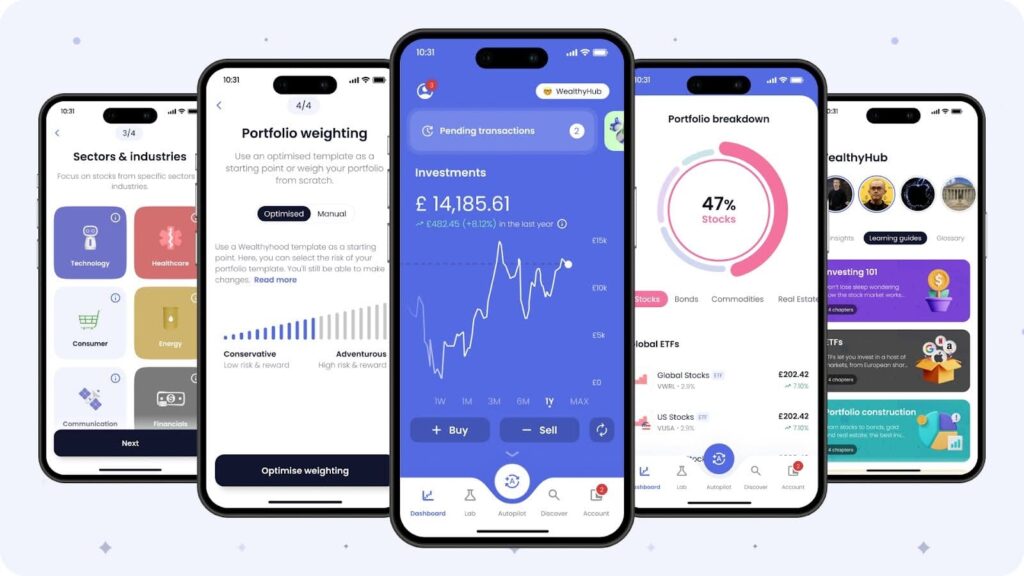
Wealthyhood is a prime example of how AI is transforming personal finance. This innovative platform uses AI to offer a range of services designed to empower investors of all levels. By analysing your financial profile, risk tolerance, and investment goals, Wealthyhood’s AI algorithms recommend suitable investment portfolios.
Challenges and Considerations
One of the primary concerns with AI tools is data privacy and security. Since AI algorithms rely heavily on data to learn and make predictions, there’s a risk that sensitive financial information could be compromised.
The rapid evolution of AI in finance has also raised the need for clear regulatory frameworks. While regulations are slowly catching up, there’s still a lot of ground to cover.
Another challenge is the potential for biases in AI algorithms. These biases can arise from the data used to train the algorithms or from the design of the algorithms themselves. If not addressed, these biases could lead to discriminatory or unfair financial outcomes.
Moreover, there’s the question of over-reliance on AI. While AI can offer valuable insights and recommendations, it’s important to remember that it’s not a substitute for human judgment and expertise.
Conclusion
In conclusion, AI is ushering in a new era of personal finance, empowering individuals with tools and insights that were once the exclusive domain of financial professionals. From personalised advice to automated tasks, AI is simplifying financial management and democratising access to financial services.