
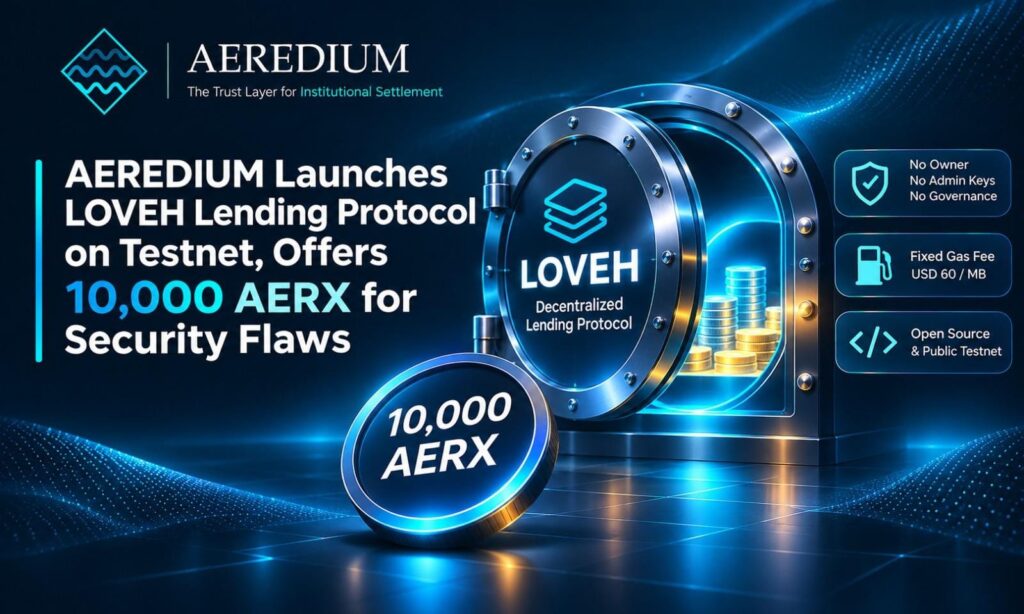
The new DeFi lending protocol uses fixed transaction fees to prevent borrowers from facing liquidation simply because network costs have become too expensive.
In decentralized finance, borrowers can lose their collateral when market conditions turn against them. But falling asset prices are not the only concern. During periods of heavy network congestion, transaction fees can rise sharply, making it expensive for borrowers to repay loans or add collateral before liquidation.
AEREDIUM, a Layer 1 blockchain network, has introduced LOVEH, a decentralized lending protocol now available on its public testnet. Its central promise is that borrowers should never lose their positions simply because gas fees have become too expensive to execute the transactions needed to protect them.
The protocol attempts to address this issue through a fixed transaction-fee structure designed to keep network costs predictable, even during periods of market volatility.
Why Gas Fees Matter in DeFi Lending
Most decentralized lending platforms require borrowers to maintain a minimum level of collateral relative to their outstanding loans. If the value of that collateral falls below a certain threshold, their positions become eligible for liquidation.
Borrowers can often avoid liquidation by depositing additional collateral or repaying part of their debt. However, these actions require blockchain transactions, and transaction fees can become particularly expensive during periods of market volatility.
LOVEH takes a different approach by operating on AEREDIUM’s blockchain, where gas fees are published at $60 per megabyte of transaction data rather than fluctuating in response to network demand.
The idea is to ensure that transaction costs remain predictable even when markets become volatile, allowing borrowers to manage their collateral without facing sudden fee increases.
Importantly, this does not eliminate conventional liquidation risk. Borrowers can still lose collateral if their positions fall below the required thresholds. Instead, LOVEH aims to prevent liquidations caused solely by transaction fees becoming prohibitively expensive.
Removing Administrative Control From Lending
The protocol also takes an unusually restrictive approach to administration.
Unlike lending platforms that retain governance mechanisms or privileged administrative keys, LOVEH is designed to operate without an owner. Once its smart contracts are deployed, even the original developers cannot pause the system or change its rules.
This removes the possibility of administrative intervention but introduces a different challenge: vulnerabilities discovered after deployment cannot be addressed through conventional contract upgrades.
To examine that risk before introducing real funds, the AEREDIUM Foundation has opened the protocol to public security testing, offering 10,000 AERX in airdrop points for each confirmed qualifying vulnerability.
Researchers are being encouraged to investigate flaws that could result in unauthorized asset transfers, locked funds, or liquidations that violate the protocol’s documented rules.
LOVEH is currently accessible on AEREDIUM’s public testnet (Chain ID: 2237), where developers can create lending markets and interact with its smart contracts.
Testing a Different Approach to DeFi Risk
LOVEH also uses an interest rate model calibrated against the three largest USDC lending pools on Ethereum, drawing on existing lending market data rather than introducing an entirely new pricing framework.
Its more distinctive experiment lies in combining immutable smart contracts with predictable transaction fees.
Whether fixed gas fees can meaningfully reduce liquidation-related risks in practice remains to be demonstrated. Predictable fees do not necessarily guarantee timely transaction execution, particularly during periods of significant network activity.
For now, LOVEH remains in its testing phase, with its code publicly available for examination and security researchers invited to challenge the protocol before it handles real assets.
The project’s source code and vulnerability reporting instructions are available on GitHub, with additional technical details published on the AEREDIUM website.