
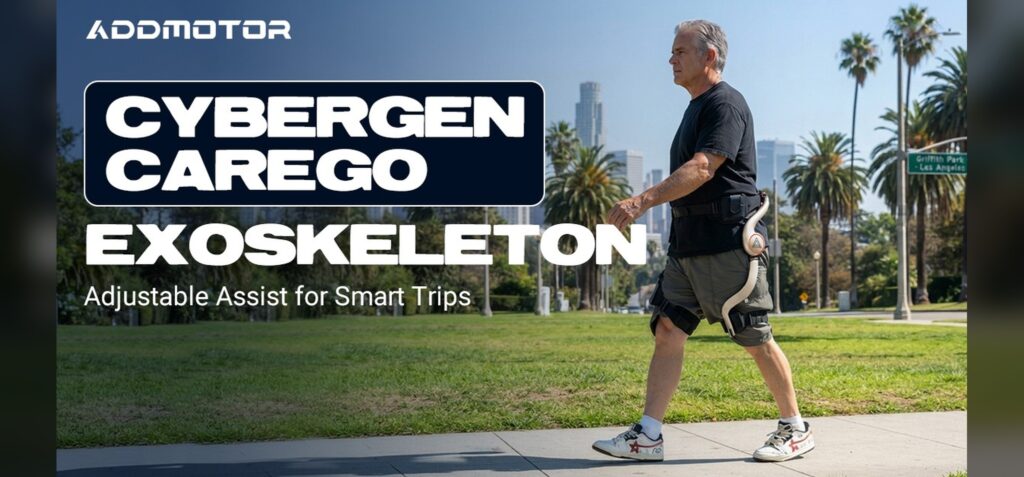
An empirical teardown of the Addmotor Cybergen Carego reveals that its movement synchronization, load-redistribution efficiency, and adaptive gait assistance are the direct result of specific mechanical, electromechanical, and algorithmic design choices rather than generic consumer assembly configurations. By integrating an aerospace-grade magnesium alloy monocoque frame, S-curve bionic leg bars, a 1000W peak dual-motor drivetrain, a dual hot-swappable 3000 mAh battery architecture, and a closed-loop AI motion engine operating with millisecond-level latency, the device establishes a clear causal link between its engineering blueprint and its real-world walking performance.
1. Key Engineering Specifications
The following specification matrix summarizes the primary electromechanical, algorithmic, and structural parameters of the Cybergen Carego Exoskeleton platform as verified through technical documentation and teardown analysis:
| Component Parameter | Technical Specification |
|---|---|
| Drivetrain Configuration | High-Density Dual-Motor Actuation System |
| Peak Power Output | 1000W Peak Power |
| Peak Mechanical Torque | 40 N·m Peak Torque |
| Maximum Assist Ratio | Up to 45% |
| Maximum Assist Speed | 5.3 mph (8.5 km/h) |
| Structural Frame Material | Aerospace-Grade Magnesium Alloy |
| Net Chassis Weight | 2.0 kg (4.4 lbs) Net Weight (Excluding Battery) |
| Energy Storage System | Dual 3000 mAh Hot-Swappable Li-Ion Modules (6000 mAh Total) |
| Range | Up to 15 Miles (24 km) |
| Ingress Protection & Temp | IP54 Dust & Water Resistant | -20°C to 60°C Operating Limit |
| Control Engine Architecture | Onboard High-Compute AI Processor & Motor Controller |
| Sensor Perception Matrix | Solid-State IMUs, Multi-Axis Gyroscopes, Accelerometers & Strain Sensors |
| Control Latency | Millisecond-Level Real-Time Intent Recognition & Actuation |
| Biomechanical Interfaces | S-Curve Bionic Leg Bars, Custom Waist Fit, Anti-Slip Mesh, Padded Shoulder Straps |
| App Operational Modes | Smart Exercise, Smart Relaxation, Smart Left-Leg Assist, Smart Right-Leg Assist |
| Digital Ecosystem | Bluetooth 5.0 Connectivity, Addmotor App Sync, OTA Updates |
| Regulatory Classification | Consumer-Grade Wearable Electronic Device (Non-FDA Medical Device) |
2. Structural Metallurgy and Load-Redistribution Biomechanics
Conventional robotic exoskeletons developed for industrial or military deployments frequently rely on heavy tubular steel or thick aluminum weldments. These structures often push net chassis weight beyond 5.0 kg, creating high mechanical inertia that severely restricts natural leg movement during unassisted swing phases.
The Cybergen Carego circumvents this inertia penalty through a monocoque frame pressure-molded from high-strength aerospace-grade magnesium alloy. Weighing just 2.0 kg (4.4 lbs) without batteries, the magnesium alloy frame achieves superior specific stiffness and vibration damping compared to standard 6061 aluminum, while maintaining high impact resistance.
Biomechanical force distribution is governed by an integrated ergonomic framework:
- S-Curve Bionic Leg Bars: The bars are molded into a 3D S-curve geometry that closely tracks the physiological contours. This bionic profile aligns the mechanical pivot points directly with the transverse hip axis, preventing shear misalignment during gait flexion and extension.
- Multi-Point Load Redistribution: Rather than concentrating reaction forces on the lower lumbar spine, the Cybergen Carego exoskeleton utilizes a custom waist-fit structural belt paired with padded shoulder straps and an anti-slip, breathable mesh contact lining. Vertical reaction loads are distributed horizontally across the iliac crest, pelvic girdle, and mid-thigh load-bearing contact points.
- Kinematic Alignment: This structural arrangement neutralizes localized pressure points and prevents frame rotation during rapid changes in gait velocity, ensuring that motor torque is transferred efficiently into leg movement.
3. AI Motion Engine Close Loop
The core operational intelligence of the Cybergen Exoskeleton Series relies on an AI motion engine designed to eliminate the artificial latency and jerky transitions typical of rule-based control systems. The software operates on a continuous, closed-loop Sense–Interpret–Assist pipeline:
- Sense (Multi-Sensor State Estimation): An array of high-frequency sensors—including solid-state Inertial Measurement Units (IMUs), multi-axis gyroscopes, accelerometers, and joint strain sensors—monitors limb acceleration, joint angle velocity, and torso tilt hundreds to thousands of times per second. Raw telemetry streams are compressed into real-time state vectors representing stride cadence, angular velocity, and elevation gradient.
- Interpret (Neural Gait-Phase Prediction): An onboard high-compute AI processing chip executes deep reinforcement learning algorithms trained against comprehensive human biomechanical gait libraries. Down to the millisecond, the neural model performs intent recognition, gait-phase segmentation (heel-strike, stance, toe-off, and swing phases), and required-torque estimation. The system anticipates the user's intended step length and velocity before mechanical muscle contraction fully develops.
- Assist (Millisecond-Level Actuation): The control layer translates gait predictions into phase-anchored motor actuation. Torque is applied at step initiation to support hip flexion and disengages instantly upon step completion or an abrupt stop. By operating with millisecond-level responsiveness, the actuation loop provides fluid power assistance that feels like an extension of natural muscle activity.
4. Electromechanical Powertrain and Dual-Motor Actuation Dynamics
Mechanical assistance is generated by a high-density dual-motor drive system positioned at the lateral hip joints. The dual motors deliver up to 1000W of peak system power and 40 N·m of mechanical torque, providing up to a 45% maximum assist ratio.
To optimize the device for daily walking, urban strolling, and casual mobility, Addmotor specifically calibrated the Carego's maximum assist speed to 5.3 mph (8.5 km/h). This speed cap aligns precisely with normal to brisk human walking cadences, preventing the erratic over-speed conditions that occur when high-rpm outdoor sports algorithms are applied to pedestrian environments.
When ascending urban inclines, ramps, or stairs, the dual motors generate concentric upward drive to reduce quad and glute fatigue. On flat pavement, the system delivers synchronized push-and-pull assistance, smoothly assisting forward leg propulsion.
5. Energy Storage Architecture: Dual Hot-Swappable Battery System
The Cybergen Carego incorporates a dual-battery architecture using hot-swappable 3000 mAh removable lithium-ion modules ( 6000 mAh total capacity).
- Weight Distribution: Splitting the battery capacity into two 3000 mAh modules mounted laterally on the frame keeps the center of mass close to the user's body, minimizing rotational inertia during leg swing.
- Range and Thermal Management: The dual-battery configuration delivers up to 15 miles (24 km) of powered walking assistance, corresponding to 5 to 6 hours of continuous use per charge. An integrated Smart Battery Management System (BMS) balances current discharge across both modules, preventing localized thermal buildup during sustained hill climbs.
- Weather Isolation: Encased in an IP54-rated weatherproof housing, the energy storage matrix operates across ambient temperatures ranging from -20°C to 60°C (-4°F to 140°F).
6. App-Integrated Operational Modes and Real-World Walking Scenarios
The Cybergen Carego connects to iOS and Android smartphones via Bluetooth 5.0, utilizing the Addmotor App as a digital control center for real-time tracking and mode adjustment.
6.1 App-Integrated Operational Modes
- Smart Exercise Mode: Delivers dynamic, higher-level assist torque tuned for urban park inclines, outdoor walking paths, and active fitness walks.
- Smart Relaxation Mode: Deploys a smooth, progressive assist curve for an effortless, comfortable pace during routine flat-ground walking, neighborhood strolls, and long-distance sightseeing.
- Smart Left-Leg Assist Mode: Provides adjustable assistance.
- Smart Right-Leg Assist Mode: Provides adjustable assistance.
6.2 Real-World Walking Application Scenarios
- Daily Walking: On city sidewalks and paved park trails, the Cybergen Carego delivers responsive assistance for a natural, enjoyable pace during extended neighborhood walks and urban exploration.
- Incline and Stair Navigation: When encountering pedestrian overpasses, park hills, or outdoor staircases, the AI algorithms adjust torque output with near-zero latency, maintaining responsive momentum on inclines and steps.
7. Regulatory Compliance Notice
To establish clear operational parameters, Addmotor defines the Cybergen Carego strictly within the consumer wearable technology category:
Regulatory Classification Notice: The Addmotor Cybergen Carego is engineered as a consumer-grade wearable electronic device designed to assist with daily walking. The device is not cleared or approved by the U.S. Food and Drug Administration (FDA) as a medical device. It is not intended for clinical rehabilitation, physical therapy, gait retraining, or medical treatment, and should not be used as a replacement for prescribed medical mobility aids or orthopedic braces.
8. Conclusion
The technical architecture of the Addmotor Cybergen Carego demonstrates how advanced robotics can be successfully adapted for everyday consumer mobility. By combining a 2.0 kg (4.4-lb net frame weight) aerospace magnesium alloy frame, bionic S-curve leg bars, a 1000W peak dual-motor powertrain, a dual 3000 mAh battery system, and an AI motion engine with near-zero latency, the Carego delivers intuitive, reliable assistance for daily walking. Through thoughtful structural engineering and responsive motion tracking, Addmotor has produced an accessible wearable powered exoskeleton that integrates into natural walking dynamics for an enjoyable everyday mobility experience.