
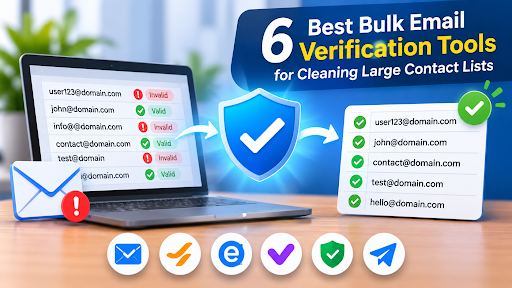
Managing a large email database requires more than collecting contact information and adding it to a marketing platform. Over time, email lists accumulate invalid addresses, abandoned mailboxes, disposable accounts, and contacts that are no longer reachable. Sending campaigns to these addresses can increase bounce rates and create problems for businesses that depend on email communication.
Bulk email verification tools help address this issue by checking hundreds or thousands of email addresses in a single process. Instead of manually testing individual contacts, businesses can upload an existing database, run automated verification checks, and download categorized results for further use.
However, choosing the right platform requires looking beyond the number of addresses it can process. Verification depth, catch-all detection, processing speed, API availability, pricing, and integration options all influence how useful a service will be for a particular business.
Below are seven bulk email verification tools worth considering for cleaning contact databases and maintaining better email list quality.
1. ZeroBounce
ZeroBounce is an email verification platform designed for businesses that need to maintain large contact databases and improve their email marketing operations. It provides bulk verification alongside several additional features related to email deliverability.
Users can upload contact lists for automated verification and receive categorized results that help distinguish valid addresses from invalid, disposable, abuse-related, and other potentially problematic contacts.
One of ZeroBounce’s useful capabilities is its additional email intelligence functionality. Beyond standard list cleaning, the platform provides services such as email activity data, deliverability testing, and blacklist monitoring.
For organizations that process contact information regularly, ZeroBounce also offers API access and integrations that can connect verification workflows with existing business systems.
Key features:
- Bulk email list verification
- Disposable and abuse-related email detection
- Catch-all email identification
- Email activity information
- Real-time verification API
- Email deliverability and blacklist monitoring
Best for: Established businesses and marketing teams that need bulk verification alongside additional email deliverability services.
Website: https://www.zerobounce.net/
2. NeverBounce
NeverBounce is a dedicated email verification service that helps businesses clean existing contact databases and identify addresses that could cause delivery problems.
Its bulk verification functionality allows users to upload large lists and process them through automated checks. The results help separate valid, invalid, and uncertain addresses so businesses can make better decisions about which contacts to retain.
The platform also supports real-time verification through its API. This is particularly useful for companies that collect new email addresses through registration pages, newsletter forms, and other online channels.
Another useful feature is NeverBounce Sync, which supports ongoing list maintenance by connecting email verification with supported marketing platforms. Rather than waiting until a campaign is ready, businesses can maintain cleaner databases as their contact information changes.
Key features:
- Bulk email verification and list cleaning
- Real-time email verification API
- Automated list maintenance
- Duplicate and invalid address identification
- Marketing platform integrations
- Verification reporting
Best for: Businesses that regularly update large contact databases and want ongoing verification integrated into their marketing operations.
Website: https://neverbounce.com/
3. Verifox
Verifox is an email verification platform that supports individual checks, bulk CSV processing, and API-based verification. It is designed for businesses that need to validate existing contact databases without checking every address individually.
Its bulk email verification functionality allows users to upload a CSV file or paste a list of email addresses. The platform then processes the entries using the same nine-layer verification engine used for individual checks and API requests.
The verification process examines multiple signals, including email syntax, DNS records, MX records, live SMTP responses, disposable email providers, role-based addresses, catch-all domains, domain age, and email authentication records.
One feature worth considering is its catch-all confidence scoring. Catch-all domains can make list cleaning difficult because their mail servers may accept messages regardless of whether a specific mailbox exists. Verifox uses additional signals and AI-based confidence scoring to help assess these uncertain addresses rather than automatically treating every catch-all result as valid.
After processing, users receive categorized results that separate valid, risky, and invalid addresses. This makes it easier to review a database before importing the cleaned results into a CRM or email marketing platform.
Verifox also provides API access for businesses that want to automate verification rather than manually uploading files each time.
Key features:
- Bulk CSV email verification
- Nine-layer verification engine
- Live SMTP and DNS checks
- Catch-all detection with AI confidence scoring
- Disposable and role-based address detection
- Valid, risky, and invalid result categorization
- REST API and MCP server support
- Free verification credits and non-expiring paid credits
Best for: Businesses, agencies, and outreach teams that need bulk contact list cleaning with detailed verification results and API support.
For businesses processing larger contact databases, the Verifox bulk email checker provides a way to verify multiple addresses in one workflow instead of relying on individual checks.
Website: https://verifox.ai/
4. Bouncer
Bouncer is an email verification service designed to help businesses maintain accurate contact lists and reduce unnecessary email bounces. It supports both individual verification and bulk list cleaning.
Users can upload existing databases and receive categorized verification results. The platform examines different email characteristics to identify invalid and potentially risky addresses, including disposable and catch-all accounts.
Bouncer also provides an API that allows developers to integrate verification into websites, applications, and other business systems. This is useful for companies that want to validate new contacts as they enter their databases rather than cleaning everything later.
Another consideration is its approach to verification credits. Bouncer’s pricing model includes provisions for duplicate and unknown results, which can be relevant when calculating the cost of processing large lists.
Key features:
- Bulk email verification
- Real-time verification API
- Disposable email detection
- Catch-all identification
- Duplicate address handling
- Email deliverability services
Best for: Marketing agencies and businesses that need flexible bulk verification and ongoing email database maintenance.
Website: https://www.usebouncer.com/
5. MillionVerifier
MillionVerifier is a bulk email verification service focused on helping businesses clean large contact databases at a relatively accessible cost.
The platform allows users to upload email lists and process multiple addresses through automated verification. It categorizes results to help users identify addresses that are suitable for continued use and those that may create delivery problems.
One of its notable features is its focus on large-volume list cleaning. Businesses can purchase verification credits based on their requirements rather than necessarily committing to an ongoing monthly subscription.
MillionVerifier also offers real-time email verification through its API, which can help prevent invalid addresses from entering a database in the first place.
For organizations that clean their lists occasionally rather than continuously, its credit-based approach may provide a practical alternative to subscription-focused services.
Key features:
- Bulk email list cleaning
- Disposable address detection
- Catch-all and risky address identification
- Real-time email verification API
- Credit-based verification options
- Automated verification workflows
Best for: Businesses and agencies that regularly process large email databases and want a credit-based verification solution.
Website: https://millionverifier.com/
6. DeBounce
DeBounce is an email verification platform that provides bulk list cleaning, real-time verification, and additional tools for maintaining email database quality.
Its bulk verification service allows users to upload contact lists and identify invalid, disposable, duplicate, and potentially risky addresses. This helps businesses organize their databases before sending marketing campaigns or conducting outreach.
DeBounce also offers an API for integrating verification into existing systems. Businesses can use it to check new email addresses as they are submitted through website forms or added to their applications.
Another useful capability is its support for additional list-management operations, including duplicate removal and certain email address checks that help improve the quality of uploaded databases.
The platform uses a credit-based pricing structure, which can appeal to businesses that want to purchase verification capacity according to their processing requirements.
Key features:
- Bulk email verification
- Duplicate email removal
- Disposable email detection
- Catch-all address identification
- Real-time API verification
- Credit-based pricing options
Best for: Small businesses, agencies, and developers looking for bulk verification with additional contact list cleaning capabilities.
Website: https://debounce.com/
What to Consider When Choosing a Bulk Email Verification Tool
Not every email verification service is designed for the same type of business. Some focus on large one-time database cleanups, while others are better suited to continuous verification through APIs.
Before selecting a platform, consider the following factors.
1. Verification Depth
A basic email check may identify formatting errors and invalid domains, but more comprehensive verification requires additional checks.
Look for platforms that examine DNS and MX records, perform SMTP checks, and identify disposable, role-based, and catch-all addresses.
A detailed verification process can provide more useful information when deciding which contacts to retain.
2. Bulk Processing Capacity
If you manage thousands of contacts, processing capacity becomes an important consideration.
Check whether a platform supports CSV uploads, large database imports, batch processing, and downloadable results. Also consider how long it takes to process a list and whether large jobs can run without constant manual supervision.
3. Catch-All Email Handling
Catch-all domains create a particular challenge for bulk verification. Their mail servers may accept messages sent to nonexistent addresses, making it difficult to establish whether an individual mailbox is active.
A useful verification platform should identify these domains and distinguish uncertain results from addresses that have been more confidently validated.
4. API and Automation Support
Businesses that collect new contacts continuously may benefit from API-based verification.
An API can automatically check addresses during registration, lead collection, or CRM imports. This reduces the need for repeated manual list-cleaning exercises.
If your business uses automation tools, check whether the verification service supports the integrations and API functionality required by your existing workflow.
5. Pricing and Credit Expiration
Bulk verification costs can become significant when processing large databases regularly.
Compare the price per verification, minimum purchase requirements, subscription costs, and whether unused credits expire.
A pay-as-you-go model may be more suitable for businesses that clean their databases occasionally, while recurring subscriptions can make sense for teams with consistent verification requirements.
6. Data Privacy and Security
Email lists can contain valuable customer and prospect information. Before uploading a database, review how the provider handles submitted addresses, how long information is retained, and which security or compliance measures it documents.
This is particularly important for businesses handling customer information across different countries.
Final Thoughts
Bulk email verification is an important part of maintaining reliable contact databases. Whether a business manages newsletter subscribers, customer records, or B2B prospect lists, regularly identifying invalid and risky addresses can help reduce avoidable delivery problems.
ZeroBounce and NeverBounce provide established options for businesses managing ongoing email marketing operations. Verifox offers bulk CSV processing with a multi-layer verification engine, while Bouncer provides flexible list cleaning and API capabilities. MillionVerifier is worth considering for larger credit-based verification jobs, and DeBounce and Emailable offer additional options for businesses with different list-management requirements.
The best platform depends on the size of your database, how frequently you clean it, and whether you need automated verification alongside bulk processing.
Before committing to a paid plan, test a sample of your own contact list. Comparing how different services classify valid, invalid, risky, and catch-all addresses can help you choose a solution that fits your actual email verification requirements.