

The AI search tooling category went from a handful of products to dozens in about two years. For B2B marketers trying to show up when buyers ask ChatGPT, Perplexity, and Gemini for recommendations, the hard question is no longer whether to invest but which tool to invest in, because on a demo they all look roughly the same: a score, a competitor chart, a trend line.
Peec AI is often the first name teams hear, so a lot of them start by searching for Peec AI alternatives to map the wider field before committing. That is a smart instinct, because these tools split into very different jobs once you look past the dashboards. Some only measure where you stand. Some do the work of changing it.
The shortlist below covers that whole range, with a note on who each tool actually suits.
- Chosenly: the execution-first platform for B2B
Chosenly is the most complete option here for teams that need to act on their visibility data rather than just read it. Instead of tracking a fixed prompt list, it maps your whole category from a single seed keyword, surfacing every purchase-intent search along with the criteria models use to pick one vendor over another.
It then runs the full workflow inside one platform: drafting and refreshing pages, prioritizing and running listicle outreach, automating Reddit, and handling positioning, all reading from the same data.
Pricing is $400 a month with unlimited seats, dedicated Slack support, and weekly GEO strategy calls.
It is built exclusively for B2B and is not suited to B2C or e-commerce, but for B2B teams the payoff is real: one customer traced a $120k deal back to a ChatGPT recommendation. Best for teams whose bottleneck is execution, not data.
- AthenaHQ
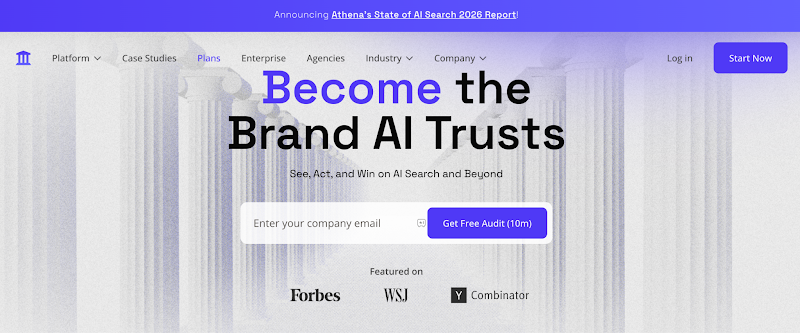
AthenaHQ sits between pure monitoring and execution. Alongside brand monitoring and prompt-volume tracking, its Action Center turns findings into recommended steps, and it supports B2B prompt mapping and AI-generated content, which makes it more actionable than a plain dashboard.
Pricing starts around $295 a month and rises to roughly $595 for growth features, with custom enterprise tiers above that. It is a reasonable fit for enterprise B2B teams that want monitoring plus a nudge toward what to do next, though the heavier lifting of outreach and community work still sits with your team.
Best for enterprise B2B teams that want monitoring with a built-in action layer.
- AI Peekaboo
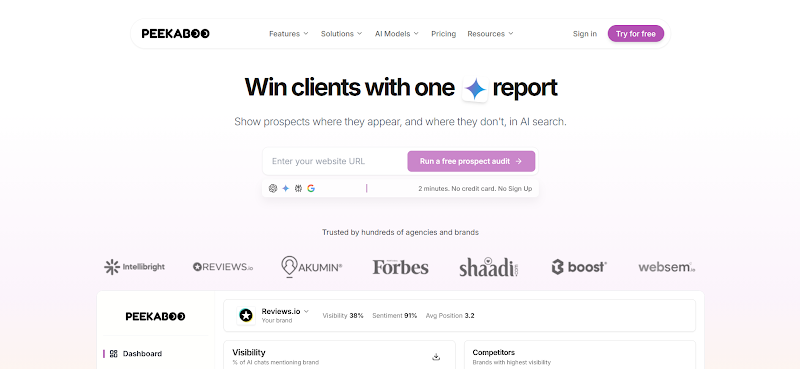
AI Peekaboo stands out for how it gathers data. It captures from the real interfaces of ChatGPT, Perplexity, Gemini, Google AI Overviews, and Google AI Mode, so you see what your buyers actually see rather than an API approximation. Its dashboard sets share of voice, average mention position, and sentiment next to named competitors, updated daily on higher tiers, and its citation breakdown catalogs more than 1,000 domains by type so you can tell where your trust signals come from.
The Starter plan caps at 40 prompts, and there is no Claude or Copilot coverage yet.
Best for agencies and SMBs that want UI-captured data across five engines without enterprise pricing.
- Profound
Profound is the pick for enterprise teams that want depth and scale. It tracks across a wide set of models, including ChatGPT, Perplexity, Copilot, Grok, and Meta AI, and its Conversation Explorer surfaces what large volumes of real users are asking, which is genuinely useful demand signal. Agent analytics show how AI systems crawl and use your site, and it has shopping tracking for product placement.
It is priced for larger teams, starting around $499 a month and moving to custom enterprise plans, and it leans toward intelligence rather than doing the work for you.
Best for enterprise brands that already have a team to act on the insights.
- Relixir
Relixir leans hardest into automation. It covers the usual visibility, source, and benchmarking tracking, but its calling card is automated content: it generates briefs, runs an optimization hub, and can continuously refresh content to keep you present in answers. That makes it appealing for B2B SaaS and D2C teams that want to move from insight to published content quickly without staffing up a content pod.
Pricing is not published, so you will need to talk to them to scope it.
Best for B2B SaaS and D2C teams that want content execution largely automated.
How to choose a GEO tool?
Most of the confusion disappears if you run any tool you are considering through a few quick checks:.
- Judge the data before the dashboard:Ask where the numbers come from. Tools that capture from the real ChatGPT, Perplexity, and Gemini interfaces reflect what buyers actually see, while ones that pull from a raw API can miss the retrieved content that shapes real answers.
- Check how prompts get added:A lot of tools have a pre-built prompt database. They don’t run prompts specific to your brand in real-time.
- Look for a guardrail on dead prompts: Some questions never surface a vendor at all. A good tool flags those so they are not quietly inflating or deflating your visibility score for no reason.
- Separate measuring from doing:Monitoring, source analysis, and even auto-generated content briefs all end in a to-do list. If your team cannot staff the writing, outreach, and community work that list creates, a nicer dashboard will not move your rankings.
- Match the tool to your situation:Match the tool to the job you actually need done, not to the tool with the nicest charts.