
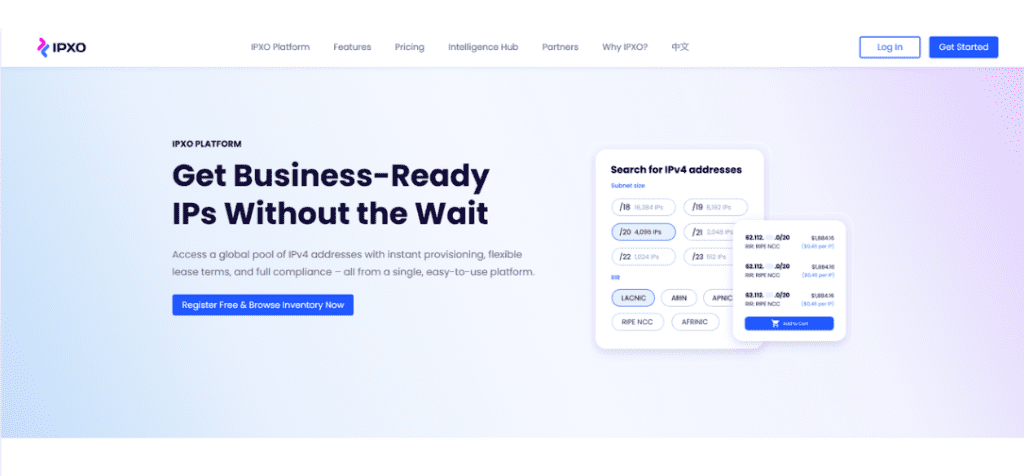
Through 2024, IPv4 leasing stayed surprisingly steady at about $0.50 per IP per month. That happened even while purchase prices moved around a lot depending on block size. Big blocks like /16s corrected sharply, while smaller blocks (/20–/24) held their value better.
Why the split? More enterprises stopped buying huge chunks “just in case.” Instead, they started picking up only what they needed, where they needed it. At the same time, leasing kept looking like the safer play. It works more like a subscription: predictable costs, easier scaling, and less exposure to timing the market.
By the end of 2024, the leasing market felt boring – in a good way. Prices were easy to plan around. Utilization stayed healthy. And because modern leasing platforms put real effort into abuse handling, KYC, and reputation tooling, buyers got cleaner IPs with fewer surprises. The result was simple: leasing stayed the low-risk way to secure IPv4 supply in an unstable market.
What changed in 2025 so far (Q1–Q3)
In 2025, IPv4 leasing prices eased slightly, but overall utilization on the IPXO platform remained strong. Over the last 90 days, the average leasing rate was $0.40 per IP, with utilization above 80%. This shows that demand hasn’t disappeared; buyers have become more price-conscious, and supply is allocated more efficiently through other leasing platforms.
At the same time, purchase market volatility continued. A key milestone came in June 2025, when /16 block prices dropped below $20 per IP for the first time since 2019. For many CFOs, this highlights that buying IPv4 addresses is still a capital-intensive and timing-sensitive decision, particularly for large block acquisitions.
Despite pricing shifts, macro demand drivers remain strong. The rapid growth of AI data collection, cloud infrastructure, and IoT workloads continues to fuel the need for routable IPv4 addresses, both at the network edge and within hybrid architectures. While global IPv6 adoption is progressing, it isn’t advancing fast enough to significantly reduce IPv4 demand soon, keeping IPv4 leasing highly relevant across regions and use cases.
Pricing benchmarks by region (2025)
IPXO’s live dashboard remains the best pulse-check for leasing levels across RIRs. Current platform-wide averages are $0.40/IP (last 90 days), with utilization ~80%. Regional spreads continue to reflect policy, scarcity, and demand dynamics:
- APNIC (Asia-Pacific): Still commands a premium when supply is tight; policy posture historically limits broad monetization (except legacy), which constrains liquid supply and props up lease rates.
- RIPE NCC & ARIN: Deep, liquid supply and active monetization keep pricing orderly; these regions traditionally anchor global averages on platforms like IPXO. (Use IPXO Market Stats for weekly deltas.)
- LACNIC & AFRINIC: Competitive pricing with pockets of variance tied to local policy, geolocation needs, and sector-specific demand.
Emerging factors shaping price in 2025
- Policy gating and RIR nuance. Where leasing is constrained or administratively discouraged, price premia persist because holders are less willing/able to monetize directly. APNIC’s stance (e.g., addresses tied to connectivity services, limited leasing structures) is the classic example affecting supply dynamics.
- IPv6 progress, but not consistency. Annual IPv6 growth continues, however, most organizations still require dual-stack or v4 reachability for customers, third-party integrations, and email deliverability, supporting ongoing IPv4 leasing demand into 2026.
- Abuse automation and reputation quality. A trustworthy market matters. IPXO’s automation handles ~97.7% of abuse cases, and the incident mix (spam, brute force, DMCA, etc.) is published with shares by type. Better automated remediation means fewer sustained blocklist events, which means more stable lease pricing.
- Block-size strategies. On the buy side, 2025 shows the widest divergence between large blocks (/16 and bigger) and mid/smaller blocks (/17–/24). That divergence encourages enterprises to lease tactically (right-sizing by region and project) instead of buying at scale and carrying depreciation risk.
What the future holds, going from 2025 into 2026
Looking into 2026, IPv4 leasing should stay resilient, even if the purchase market keeps swinging. Based on current platform data and the direction of RIR policies, most regions are likely to hold in a $0.38–$0.45 per IP range through much of the year. APNIC is the main outlier. With tighter supply and more policy friction, leasing there may stay above $0.60 per IP unless the rules loosen.
For fast-growing tech businesses, this matters more than a headline price. If you’re building in cloud, AI, fintech, Web3, or IoT, IPv4 isn’t optional yet. You still need it for customer reach, integrations, geotargeting, and predictable deliverability. That’s why smaller, flexible blocks (/24 to /22) should keep seeing steady demand. They’re easier to deploy quickly and cheaper to right-size across regions.
Policy will be the wild card. If APNIC relaxes leasing constraints, premiums could soften. If other regions tighten rules, you may see local spikes instead. Either way, most teams will keep leasing tactically – scaling up for growth, then scaling down when projects cool – instead of locking capital into large purchases with depreciation risk.
Finally, IPv6 progress isn’t moving evenly enough to take pressure off IPv4 in the near term. Adoption is rising, but dual-stack reality means IPv4 demand stays sticky in 2026. Add the continued growth of AI data collection and IoT deployments, and leasing utilization should remain around (or above) 80%, keeping prices strong for both holders and buyers.